
Key Takeaways
- Electromagnetic flow meters measure conductive liquid flow using Faraday's Law — zero moving parts, zero mechanical wear.
- They are perfect for precision-critical industries since they provide ±0.5% accuracy with no pressure loss.
- Suitable for water, chemicals, slurries, food-grade liquids, pharmaceuticals, and more.
- Bidirectional measurement capability makes them perfect for systems that need backflow monitoring.
- Fluido Sense Pvt Ltd is one of the most trusted Electromagnetic Flow Meter Manufacturers in India, serving clients globally.
Fluido Sense Pvt Ltd is a Leading Manufacturer of Electromagnetic Flow Meters in India.
Every industrial facility has one thing in common — the need to know exactly how much liquid is moving through their pipelines at any given moment. A small error in that measurement is not just a data problem. It throws off chemical dosing, disrupts production batches, creates compliance failures, and in worst cases, causes safety incidents that could have been avoided entirely.
If your plant has been dealing with unreliable flow readings, frequent meter replacements, or unexplained process variations — the instrument you are using might simply not be the right one for the job. And that is exactly what this blog is here to address.
The Electromagnetic Flow Meter in India has become the go-to solution for industries that need accurate, low-maintenance, and long-lasting flow measurement. In this blog, we walk you through what it is, how it works, where it is used, and what makes it the smart choice for modern industrial operations.
What Is an Electromagnetic Flow Meter?
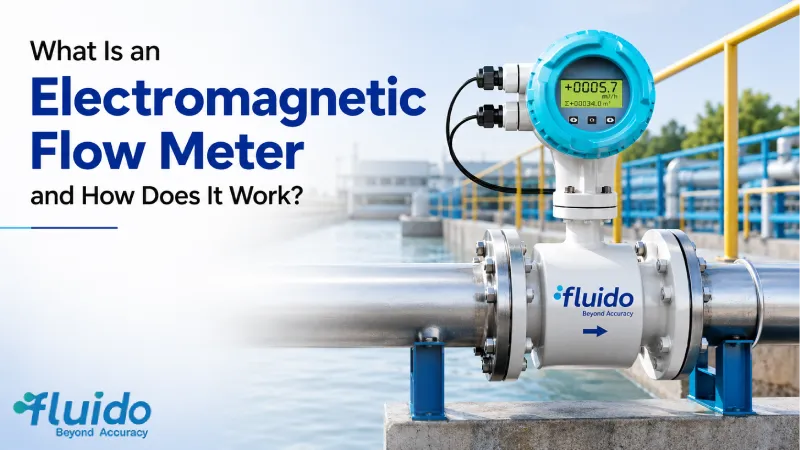
An electromagnetic flow meter — widely known as a mag flow meter — is an instrument that measures the volumetric flow rate of electrically conductive liquids passing through a pipeline. The biggest thing that separates it from older flow technologies is simple: there are no moving parts inside the flow path. No rotors, no paddles, no turbines. Nothing that spins, flexes, or wears down over time.
This is not a small advantage. In industries where liquids are abrasive, chemically aggressive, or carry suspended solids, any mechanical component in the flow path becomes a liability. It clogs, corrodes, or simply breaks — and then you have downtime, replacement costs, and inaccurate data to deal with.
WThe electromagnetic flow meter sidesteps all of that. It sits in the pipeline, generates a magnetic field across the flow, and reads the voltage that the moving liquid naturally produces. That voltage tells it exactly how fast the liquid is moving — and from that, it calculates the flow rate. Clean, non-intrusive, and remarkably reliable. At Fluido Sense Pvt Ltd this is the foundation of everything we build — instruments that work quietly in the background, delivering accurate data without demanding constant attention.
The Working Principle — Faraday's Law Made Simple
The science behind it comes from Michael Faraday's discovery back in the 1830s — when a conductor moves through a magnetic field, it generates a voltage. In a mag flow meter, that conductor is the liquid itself.
Here is how it works in practice:
Magnetic coils inside the meter body generate a controlled magnetic field that passes across the full diameter of the pipe. When conductive liquid flows through this field, a voltage is induced at right angles to both the flow direction and the magnetic field. Two electrodes mounted on opposite sides of the pipe wall pick up this voltage signal.
The transmitter that is attached to those electrodes receives the raw signal, analyzes it, and uses a known formula to transform it into a flow rate reading.The output is displayed on a local screen and simultaneously sent to your control system — via 4–20mA analog signal, pulse output, or digital protocols like HART or Modbus, depending on your setup.The whole process happens continuously, in real time, with nothing obstructing the liquid or adding resistance to the flow.
Industries That Rely on It Every Day
The range of applications is one of the most compelling things about this technology. Almost every industry that handles conductive liquids has a use for it.
Water and Wastewater Treatment
Municipal water systems and industrial effluent plants use mag flow meters to measure distribution volumes, monitor discharge compliance, and control chemical dosing with precision.
Chemical and Petrochemical Plants
Acids, alkalis, solvents, and corrosive process liquids that would destroy a conventional meter in weeks are measured reliably with the right liner and electrode material selection.
Food and Beverage Manufacturing
Sanitary-grade electromagnetic flow meters measure milk, juices, beer, and other consumables with no contamination risk, fully meeting hygienic and regulatory standards.
Pharmaceutical Production
Where even a small deviation in liquid measurement can compromise product quality, mag flow meters deliver the consistency that pharmaceutical processes demand.
Mining and Slurry Handling
Thick, abrasive slurries that wear out mechanical meters rapidly are handled comfortably by electromagnetic flow meters with hard rubber or ceramic linings.High-solids pulp suspensions that would obstruct or harm other meter types pass through mag flow meters without any problems in paper and pulp mills.
As a trusted Electromagnetic Flow Meter Exporter, Fluido Sense Pvt Ltd serves all of these industries — across India and in export markets spanning Southeast Asia, the Middle East, and Africa.
Why Engineers Keep Choosing This Technology
Beyond the no-moving-parts design, there are several practical reasons why plant engineers and procurement teams consistently specify electromagnetic flow meters.Accuracy comes first. For the majority of process control and custody transfer applications, a well-calibrated Electromagnetic Flow Meter Manufacturer’s equipment provides ±0.5% accuracy.High-precision models go as tight as ±0.2%.
There is also zero pressure drop. The liquid flows through with no additional resistance because nothing obstructs the flow channel. Over time, that means lower pumping energy costs — a real operational saving, especially in high-flow applications.
Bidirectional measurement is another genuine advantage. The meter reads flow accurately in both directions — forward and reverse — without needing two separate instruments.And the range of compatible pipe sizes is broad. From DN10 all the way up to DN2000, mag flow meters can be configured for pipelines of practically any size found in industrial settings.
A Few Things It Cannot Do
Fair reporting means covering the limitations too. Electromagnetic flow meters only work with electrically conductive liquids — a minimum conductivity of around 5 μS/cm is typically required. That rules out gases, steam, petroleum products, and non-conductive liquids like pure or deionised water.The pipe also needs to run full at all times. Partial pipe flow or air pockets near the electrodes will produce inaccurate readings.
These are manageable constraints — and our team at Fluido Sense Pvt Ltd works closely with every customer to confirm that the application is a right fit before recommending a specific instrument.
Why Choose Us
We have spent years building a reputation as a dependable Electromagnetic Flow Meter Manufacturer in India — not just by making good instruments, but by standing behind them with genuine technical support and honest guidance. Our manufacturing facility follows international quality standards, and every meter goes through thorough calibration and testing before it reaches a customer. We work across industries — water, chemicals, food, pharma, mining — and our application knowledge runs deep. As an active Electromagnetic Flow Meter Exporter, we serve clients across multiple countries with the same quality and commitment we bring to every domestic order. When you choose us, you get an instrument you can trust and a team that is genuinely invested in keeping your operation running smoothly.
Conclusion
Electromagnetic flow meters have proven themselves across decades and across industries as one of the most dependable flow measurement technologies available today. No moving parts, high accuracy, zero pressure drop, and compatibility with a wide range of conductive liquids make them a smart long-term investment for any industrial facility. As the demand for precise and reliable flow measurement continues to grow across India and globally, partnering with the right Electromagnetic Flow Meter Manufacturer matters more than ever. At Fluido Sense Pvt Ltd, we bring the engineering quality, application expertise, and after-sales support to be that partner for your operation — today and for years to come.
Ready to Find the Right Electromagnetic Flow Meter for Your Application?
Talk to our team at Fluido Sense Pvt Ltd — we help you select the right instrument for your exact process conditions, backed by strong technical support and fast delivery across India and internationally.
Call us: +91 98989 58888 Or Email: sales@fluidosense.com.
FAQs
It works with any electrically conductive liquid — water, wastewater, acids, alkalis, slurries, milk, juices, and most chemical solutions. It cannot measure gases, steam, petroleum products, or non-conductive liquids like pure deionised water.
Very little, thanks to the absence of moving parts. Periodic inspection of the electrodes and liner condition is generally all that is needed to keep the instrument performing accurately over many years of continuous service.
Most industrial-grade models achieve ±0.5% accuracy. High-precision versions used in custody transfer or laboratory environments can reach ±0.2%, depending on the design and calibration standard applied.
Yes — horizontal, vertical, and inclined installations are all supported. For vertical installations, upward flow direction is recommended to maintain a full pipe condition and avoid air pockets near the electrodes.
A domestic manufacturer like Fluido Sense Pvt Ltd offers faster delivery, locally available spare parts, application-specific customisation, and direct technical support — without the lead times and additional costs that come with international sourcing.