
Key Takeaways
- Start by identifying the fluid and its characteristics to choose the best flow meter manufacturer.
- Ensure the manufacturer understands the measurement principle suitable for your application.
- Check the required flow range to ensure the meter operates effectively under your conditions.
- Evaluate the accuracy and repeatability specifications vital for reliable flow measurement.
- Select materials of construction that match the fluid compatibility and environmental pressures.
Fluido Sense Pvt Ltd is a leading manufacturer and supplier of industrial flow measurement solutions, including oval gear flow meters. Choosing the right Flow Meter Manufacturer is not only about finding a meter that fits a pipeline. The supplier should understand your fluid, flow range, accuracy requirements, installation conditions, and output needs so the selected instrument matches the actual application.
Start With Your Fluid and Application
The first step in choosing a flow meter manufacturer is understanding the liquid you need to measure. Different flow meters suit different fluid characteristics, so the supplier needs clear information about the process.
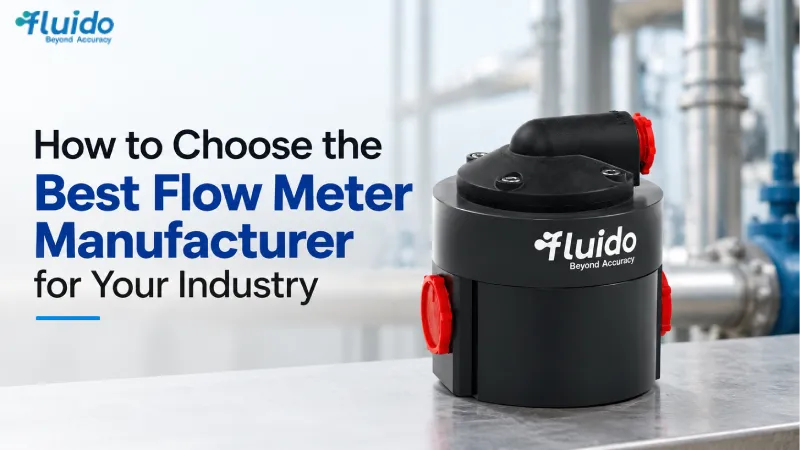
Fluido Sense states that its Oval Gear Flow Meter is designed for clean, viscous, non-abrasive liquids and lists applications such as petroleum products, oil products, chemicals, grease, fuels, and pastes.
A good flow meter selection starts with the fluid, not simply the pipe size.
Choose a Manufacturer That Understands the Measurement Principle
Flow meter technology plays an important role in the type of measurement you can achieve. An Oval Gear Flow Meter works on the positive displacement principle. Liquid enters a measuring chamber and moves two oval gears, with gear rotation corresponding to a defined volume of fluid.
This operating principle makes such meters relevant for applications where volumetric measurement of clean and viscous liquids is required.
When evaluating a Flow Meter Manufacturer, ask whether the offered measurement technology is suitable for your process rather than selecting a model only from its size or appearance.
Check the Required Flow Range
Flow range is another important selection factor. A meter needs to operate appropriately across the expected flow conditions of the application.
Fluido Sense's Oval Gear Flow Meter range covers different models from FS04 through FS80, with listed flow ranges from 0.7 to 50 LPH for the FS04 model up to 1,000 to 50,000 LPH for the FS80 model.
The available range also corresponds with different nominal connection sizes, from 1/4 inch through 3 inches.
Before ordering, share the normal, minimum, and maximum expected flow conditions with the manufacturer.
Consider Accuracy and Repeatability
Accuracy matters when flow measurement is being used for process control, batching, monitoring, or other applications where dependable readings are important.
The Fluido Sense product information lists accuracy of ±1% of reading and ±0.5% of reading at 10:1 turndown, with typical repeatability of 0.03% of reading.
However, buyers should consider the expected operating range and application conditions when reviewing these figures. The appropriate specification depends on how the instrument will be used.
Do not compare flow meters only by headline accuracy; consider accuracy and repeatability together with the actual operating conditions.
Evaluate Materials of Construction
The material of the meter can be important when the instrument is exposed to different liquids, temperatures, and pressures.
The Fluido Sense range includes aluminium and stainless-steel body options. The published specifications list maximum pressure of 25 bar for aluminium meters and 200 bar for SS 316 threaded meters.
The ordering information also identifies different rotor and sealing material options, including aluminium, stainless steel, PPS, NBR, EPDM, and Viton.
The material selection should therefore be discussed according to fluid compatibility and process conditions.
Match the Meter With the Process Temperature
Temperature is another specification that should be confirmed before purchase.
For the listed Oval Gear Flow Meter range, Fluido Sense specifies a temperature range of 20°C to 85°C for aluminium-body meters and -20°C to 120°C for stainless-steel-body meters, with other ranges available subject to factory reference.
Sharing the expected process temperature with the supplier helps narrow the appropriate configuration.
Review Output and Communication Options
A modern industrial flow meter may need to connect with instruments or control systems beyond the local measurement point.
The Fluido Sense Oval Gear Flow Meter provides Hall Effect NPN/PNP pulse output, while optional outputs include 4–20 mA and RS-485 Modbus communication. The product information also lists a pulse output configuration and different electrical connection options.
When comparing suppliers, check whether the available outputs match your PLC, display, monitoring, or automation requirements.
Consider Installation and Environmental Protection
A flow meter should be selected with its installation environment in mind.
The Fluido Sense specifications list an IP66/67 protection class for the Oval Gear Flow Meter.
Installation also involves connection type, available space, wiring, and the surrounding equipment. The ordering information includes BSP, NPT, and flange connection options, depending on the selected configuration.
The supplier should be able to discuss these details before the final model is selected.
Look at the Manufacturer's Product Range
A supplier with multiple flow measurement technologies can be useful when application requirements differ across your facility.
Fluido Sense lists several flow measurement products, including Oval Gear Flow Meters, Tri Gear Flow Meters, Tri Gear Chemical Flow Meters, Electromagnetic Flow Meters, and flow totalizers and batch controllers.
This broader product range can make technical discussions more focused because the buyer can evaluate measurement options against the process instead of forcing one meter type into every application.
Questions to Ask Before Selecting a Supplier
Before finalising a flow meter, provide the manufacturer with practical process details. A clear technical discussion can help identify the appropriate model and configuration.
- What liquid is being measured?
- Is the liquid clean, viscous, lubricating, or non-abrasive?
- What are the minimum, normal, and maximum flow rates?
- What line size and connection type are required?
- What process temperature and pressure must the meter handle?
- What accuracy and repeatability are expected?
- Which output is required: pulse, 4–20 mA, or Modbus?
- Which body, rotor, and seal materials suit the fluid?
These details help the supplier evaluate the application more accurately.
Compare Manufacturers on More Than One Factor
A useful manufacturer comparison should consider technical capability as well as product fit.
| Selection Factor | What to Check |
|---|---|
| Measurement Principle | Is the technology suitable for the fluid and process? |
| Flow Range | Does the selected model cover the expected operating range? |
| Accuracy | Does the stated accuracy match the application requirement? |
| Construction | Are body, rotor, and seal materials compatible? |
| Outputs | Can the meter integrate with the required control system? |
| Support | Can the supplier provide suitable technical guidance? |
The best supplier is not simply the one offering a flow meter; it is the one that can connect the instrument specification with your actual process.
Why Choose Us
Fluido Sense Pvt Ltd develops and supplies industrial flow measurement products for applications involving liquids such as oil, fuel, chemicals, grease, and other suitable fluids. Our Oval Gear Flow Meter range offers multiple models, flow capacities, material options, connection types, and output configurations. We focus on application-specific selection, helping B2B buyers review flow range, measurement performance, materials, temperature, pressure, and communication requirements before choosing a suitable instrument.
Conclusion
Selecting the right Flow Meter Manufacturer requires a clear understanding of your application and the technical capabilities of the supplier. Fluid properties, flow range, accuracy, repeatability, materials, temperature, pressure, installation conditions, and output requirements all influence the final choice. An Oval Gear Flow Meter can be a suitable option for clean, viscous, non-abrasive liquids where positive displacement measurement is appropriate. By discussing your actual process requirements with the manufacturer, you can move from a generic product search toward a flow measurement solution that fits your industrial application.
Looking for a suitable industrial flow meter for your application? Speak with Fluido Sense Pvt Ltd to discuss your fluid, flow range, connection, material, and output requirements.
Call: +91 98989 58888
Email: sales@fluidosense.com
FAQs
When choosing a flow meter manufacturer, consider factors such as the type of fluid you need to measure, flow range, accuracy requirements, materials of construction, and installation conditions. It's essential to discuss these details with the supplier to ensure that the selected flow meter fits your specific application.
The measurement principle significantly impacts the accuracy and suitability of a flow meter for specific liquids and applications. Manufacturers like Fluido Sense utilize principles such as positive displacement in their Oval Gear Flow Meters, which makes them ideal for clean and viscous liquids.
Accuracy in flow measurement is crucial for process control and monitoring, especially in applications where precise readings are necessary. When evaluating a flow meter manufacturer, make sure to consider not only the stated accuracy but also the repeatability of the device according to the specific operating conditions.
To ensure your flow meter meets environmental protection requirements, check the manufacturer’s specifications for the IP rating and the materials of construction. Fluido Sense’s flow meters, for example, have an IP66/67 rating, which provides a level of protection against dust and water ingress.
When selecting a flow meter manufacturer, consider the output options available with their devices. Look for compatibility with your control systems; options such as pulse outputs, 4–20 mA, and RS-485 Modbus communication can enhance integration with monitoring and automation systems.