
Key Takeaways
- Understand the specific properties of your liquid to choose effective Flow Measurement Solutions.
- Positive displacement meters are ideal for measuring high-viscosity liquids like oils and lubricants.
- Electromagnetic flow meters are suited for electrically conductive liquids, offering no moving parts.
- Ensure wetted-material compatibility when measuring chemical liquids to prevent equipment failure.
- Avoid a one-size-fits-all approach; select measurement technology based on liquid behavior.
Fluido Sense Pvt Ltd is a leading manufacturer of industrial flow meters and liquid measurement systems for applications involving oils, conductive liquids, chemicals and process automation.
Choosing Flow Measurement Solutions becomes more challenging when the liquid is highly viscous, electrically conductive or chemically aggressive. A meter that performs well with process water may not be suitable for lubricating oil, while a meter designed for oil should not automatically be selected for a corrosive chemical.
The practical approach is to start with the liquid properties and then match them to the measurement principle.
Why the Liquid Should Come Before the Flow Meter
Pipe size and expected flow rate matter, but they do not tell the complete story.
Viscosity affects how easily a liquid moves through the meter. Conductivity determines whether electromagnetic measurement is possible. Chemical composition influences which wetted materials can safely contact the process liquid.
Before comparing Flow Measurement Solutions, identify:
- Liquid name and composition
- Minimum and maximum flow rate
- Viscosity
- Electrical conductivity
- Operating temperature and pressure
- Pipe size and process connection
- Required output or communication
- Wetted-material compatibility
The best flow-meter selection starts with understanding what is actually moving through the pipe.
1. High-Viscosity Liquids: Consider Positive Displacement Measurement
High-viscosity liquids behave differently from water-like fluids. Oils, lubricants, grease and similar media can require a measurement technology capable of handling thicker liquids reliably.
Positive displacement meters are particularly relevant here because they measure discrete volumes of liquid as it moves through the meter.
Our Oval Gear Flow Meter range, for example, is designed for clean, viscous and non-abrasive liquids including petroleum products, oils, fuels, chemicals, grease and pastes.
For a high-viscosity application, check:
- Actual viscosity at operating temperature
- Minimum and maximum flow rate
- Whether the liquid contains abrasive particles
- Pressure and temperature conditions
- Required output to the control system
A clean viscous oil and an abrasive slurry may both appear “thick,” but they should not automatically use the same measurement technology.
2. Conductive Liquids: Electromagnetic Measurement Is a Strong Option
For electrically conductive liquids, electromagnetic technology can provide a very different approach.
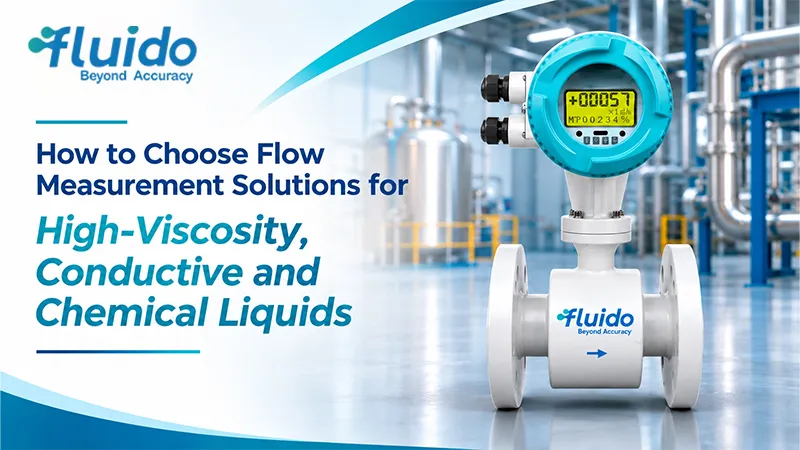
An electromagnetic flow meter measures conductive liquid without using rotating measuring components in the flow path. Fluido Sense offers electromagnetic meters from 15 NB to 600 NB, with no moving parts and options suited to different conductive-liquid applications.
This makes electromagnetic technology relevant to applications including:
- Water and wastewater
- ETP and STP processes
- Conductive chemical solutions
- Textile processing
- Dairy processing
- Food and drug industries
- Chemical and fertilizer operations
When comparing Flow Measurement Solutions for a conductive liquid, conductivity should be confirmed rather than assumed.
Oil, fuel and many other non-conductive liquids are not suitable for electromagnetic measurement simply because they are liquids.
3. Chemical Liquids: Material Compatibility Can Decide the Meter
Chemical flow measurement requires another layer of evaluation.
The first question is whether the chemical is electrically conductive. If it is, an electromagnetic meter may be suitable. The second question is whether the meter's liner, electrodes and other wetted materials are compatible with that chemical.
Fluido Sense electromagnetic meters are available with liner options and electrode materials selected according to process requirements. The current product range lists electrode choices including SS316L, Hastelloy C, Titanium and Tantalum.
This matters because “chemical liquid” is not one application category. An instrument suitable for one chemical should not be assumed suitable for another.
Our team at Fluido Sense Pvt Ltd therefore recommends reviewing the actual chemical, concentration and operating conditions before finalizing the meter configuration.
Which Technology Should You Evaluate First?
This comparison provides a practical starting point rather than a substitute for application assessment.
| Liquid Type | Technology to Evaluate | Main Selection Factor |
|---|---|---|
| Clean viscous oil | Oval Gear / positive displacement | Viscosity and flow range |
| Conductive water | Electromagnetic | Conductivity and velocity |
| Wastewater | Electromagnetic | Conductivity and installation |
| Conductive chemical | Electromagnetic | Electrode and liner compatibility |
| Clean viscous chemical | Positive displacement may be considered | Viscosity and material compatibility |
| Non-conductive oil or fuel | Positive displacement | Fluid properties and flow range |
The table highlights why Flow Measurement Solutions should be selected by fluid behaviour rather than using a single technology across every process.
Conductivity vs Viscosity: Do Not Confuse the Two
Conductivity and viscosity describe completely different characteristics.
A liquid can be highly viscous but non-conductive. Another can have low viscosity but excellent electrical conductivity. A chemical can also be conductive while requiring special wetted materials because of its corrosive nature.
For electromagnetic flow measurement, Fluido Sense states that the technology is intended for conductive liquids and is independent of fluid viscosity within suitable application conditions.
For high-viscosity, clean and non-abrasive liquids, Oval Gear technology may instead be appropriate.
Do not choose between these technologies based on viscosity alone.
What Should You Share Before Requesting a Flow Meter?
Providing complete process information helps our team narrow the appropriate technology more effectively.
Follow this sequence:
- Identify the exact liquid. Avoid descriptions such as only “chemical” or “oil.”
- Share the flow range. Include expected minimum and maximum flow.
- Specify viscosity where relevant. Include the operating temperature if viscosity changes significantly with temperature.
- Confirm conductivity. This is particularly important when considering an electromagnetic meter.
- Provide process pressure and temperature.
- State pipe size and connection requirements.
- Explain your automation needs. Include required analogue, pulse or digital communication where applicable.
Our electromagnetic meters support industrial communication and signal options including 4–20 mA, frequency output and RS485 Modbus RTU, with additional communication options available depending on configuration.
Avoid the “One Meter Fits All” Approach
The most common selection mistake is starting with a preferred meter rather than the liquid.
Good Flow Measurement Solutions should answer four basic questions:
Can the technology measure this liquid? Is the meter materially compatible with it? Does its operating range match the process? Can its output integrate with the plant's monitoring or control system?
If any of those answers is unclear, the meter should be evaluated further before specification.
Why Choose Us
At Fluido Sense Pvt Ltd, we manufacture multiple flow-measurement technologies rather than approaching every liquid with the same instrument. Our range includes Oval Gear and other positive displacement meters for suitable liquid applications, along with electromagnetic flow meters designed for conductive media. This allows our team to evaluate viscosity, conductivity, chemical compatibility, flow conditions and communication requirements before suggesting a suitable direction for industrial measurement.
Conclusion
Choosing the right Flow Measurement Solutions for difficult liquids begins with understanding the fluid itself. High-viscosity, clean liquids may favour positive displacement measurement, while conductive water and compatible conductive chemicals can be strong candidates for electromagnetic technology. Chemical applications require additional attention to wetted-material compatibility.
At Fluido Sense Pvt Ltd, we help industrial buyers evaluate these factors before choosing a flow meter, so the selected technology matches the process rather than simply matching the pipeline diameter.
Need to select a flow meter for a conductive liquid, chemical process or demanding industrial application?
Call +91 98989 58888 or email sales@fluidosense.com today with your liquid name, flow range, pipe size and process conditions to discuss a suitable flow measurement solution.
FAQs
When selecting flow measurement solutions for high-viscosity liquids, it's essential to assess the actual viscosity at operating temperature, the minimum and maximum flow rate, and whether the liquid contains abrasive particles. Additionally, consider temperature, pressure conditions, and how the output will integrate with control systems.
Electromagnetic flow measurement is favored for conductive liquids because it doesn't use moving components, which can be affected by the flow's properties. This technology is capable of accurately measuring conductive liquids such as water, wastewater, and certain chemical solutions, providing a reliable measurement without wear.
To ensure material compatibility when selecting a flow meter for chemical liquids, identify the chemical composition and concentration, and verify that the meter's wetted materials, such as liners and electrodes, can withstand the corrosive nature of the chemicals. This analysis helps prevent damage and ensures accurate measurements.
When requesting a flow measurement solution, it's crucial to provide details about the liquid, including its name and composition, flow range, viscosity, conductivity, operating temperature and pressure, along with pipe size and connection requirements. This information helps narrow down the most suitable measurement technology.
For conductive chemical processes, electromagnetic flow meters are typically the best choice, as they effectively measure the flow without obstructive moving parts. However, it's vital to confirm that the materials used in the meter are compatible with the specific chemicals to avoid any potential reactivity or degradation.
Flow Measurement Solutions Electromagnetic Flow Meter High-Viscosity Liquids Chemical Flow Measurement Conductive Liquids Industrial Flow Meter Flow Meter Selection Process Measurement Liquid Flow Measurement Process Automation